
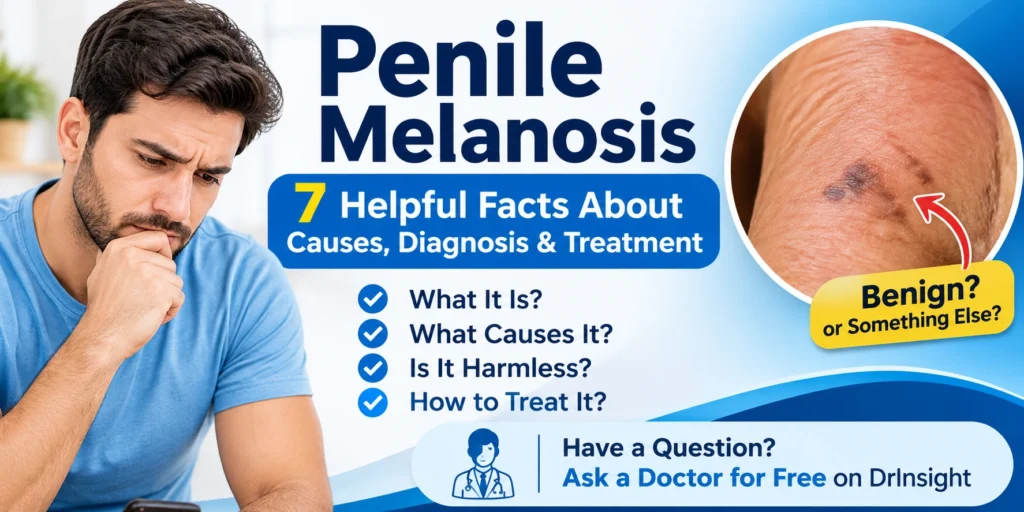
Penile Melanosis: 7 Helpful Facts About Causes, Diagnosis & Treatment
Noticing dark brown, black, or unevenly colored spots on the penis can be worrying. Many men immediately wonder whether the change is related to an infection, a sexually transmitted disease, or cancer. However, some genital skin pigmentation changes are benign and do not require treatment.
One such condition is penile melanosis, a pigmentation disorder that causes flat, darker areas on the penile skin. It is generally painless and may remain stable for years. Although it is usually harmless, other conditions can sometimes look similar, making a medical evaluation important when pigmentation is new, changing, or unusual.
Understanding what penile melanosis looks like, why it occurs, and how doctors evaluate it can help men make informed decisions without unnecessary anxiety.
1. What Is Penile Melanosis?
Penile melanosis is a benign pigmentation condition characterized by brown, dark brown, or black flat spots or patches on the penis. It is also referred to as genital melanosis or penile lentiginosis in some medical literature.
These spots develop because of increased pigmentation in the skin, particularly involving melanin, the pigment responsible for skin color. Penile melanosis does not typically cause physical symptoms such as pain, itching, burning, or discharge.
The spots may appear on the penile shaft, glans, or other genital skin areas. They can occur individually or as multiple patches, and their size and shade may vary.
Although penile melanosis is generally benign, its appearance can sometimes resemble other pigmented skin conditions. A healthcare professional may need to examine the area to determine the cause of the pigmentation rather than relying on appearance alone.
2. What Does Penile Melanosis Look Like?
Penile melanosis typically appears as flat, pigmented macules (spots) or patches on the skin. They may be light brown, dark brown, or nearly black.
Common characteristics include:
- Flat spots that are not raised above the skin
- Brown or black pigmentation
- One spot or multiple spots
- Different sizes and shapes
- Usually no pain, itching, or tenderness
- Pigmentation that may remain stable over time
Some lesions are small and clearly defined, while others may cover a larger area or have irregular outlines. Pigmentation can also vary between individuals depending on their natural skin tone.
Penile melanosis is not usually associated with pus, fluid-filled blisters, or open sores. If a spot is accompanied by ulceration, persistent irritation, bleeding, or other unusual symptoms, it should not automatically be assumed to be melanosis.
3. What Causes Penile Melanosis?
The exact cause of penile melanosis is not fully understood. It involves increased pigmentation in the affected skin, but the reason this develops in some individuals remains uncertain.
Melanin is produced by cells called melanocytes. Changes in how pigment is produced, distributed, or deposited within the skin can result in localized dark patches.
Several factors or associations have been discussed in medical literature:
Natural pigmentation and skin variation
Genital skin can naturally be darker than other parts of the body. Differences in pigmentation may be influenced by genetics, hormones, and individual skin characteristics.
Previous inflammation or irritation
Some genital skin conditions may leave behind darker pigmentation after inflammation resolves. This is known as post-inflammatory hyperpigmentation and may resemble melanosis.
Skin conditions
Certain inflammatory dermatological conditions can occur alongside genital pigmentation. When redness, itching, scaling, pain, or changes in skin texture are present, the pigmentation may not represent isolated melanosis.
Individual variation
Penile melanosis may develop without an identifiable trigger or preceding skin problem. Not every case has an obvious cause.
It is important not to assume that every dark spot on the penis is caused by friction, poor hygiene, or sexual activity. Penile melanosis is not generally considered a sexually transmitted infection.
4. Is Penile Melanosis Harmless?
Penile melanosis is generally considered a benign condition. In typical cases, the pigmented spots do not cause pain, do not affect sexual function, and do not require medical treatment.
However, benign pigmentation and melanoma can sometimes have overlapping appearances. This is the main reason that a new pigmented lesion or one that is changing should be assessed by a healthcare professional.
Seek medical evaluation if a spot:
- Changes noticeably in size, shape, or color
- Develops irregular or poorly defined borders
- Contains several different shades of color
- Becomes raised, thickened, or develops a lump
- Starts bleeding, ulcerating, or forming a persistent sore
- Is associated with pain, itching, or ongoing inflammation
These features do not automatically mean cancer. They indicate that the lesion needs a proper assessment to determine what it is.
5. Penile Melanosis vs. Penile Melanoma: What Is the Difference?
One of the most common concerns among men with penile pigmentation is whether it could be melanoma.
Penile melanosis is a benign pigmentation condition, whereas melanoma is a malignant tumor involving pigment-producing cells. Although melanoma of the penis is uncommon, it is important not to overlook suspicious lesions.
| Feature | Penile melanosis | Suspicious pigmented lesion |
|---|---|---|
| Nature | Usually benign | May require investigation to exclude malignancy |
| Appearance | Brown or black flat macules or patches | May be irregular, asymmetric, or varied in color |
| Progression | Often stable or slowly changing | May show concerning evolution |
| Symptoms | Commonly asymptomatic | May be asymptomatic or develop symptoms |
| Diagnosis | Clinical examination; biopsy if uncertain | Specialist evaluation, often biopsy if suspicious |
| Treatment | Often no treatment required | Depends on the diagnosis |
Appearance alone cannot reliably distinguish all benign lesions from melanoma. A dermatologist may use dermoscopy, a magnifying skin examination tool, to examine pigment patterns and decide whether a biopsy is needed.
If a lesion appears suspicious, biopsy and histopathological examination may be recommended. This allows the tissue to be examined under a microscope for a more definitive diagnosis.
6. How Is Penile Melanosis Diagnosed?
Diagnosis generally begins with a medical history and examination of the affected skin.
A doctor may ask:
- When did you first notice the dark spot?
- Has it changed in size, color, or shape?
- Are there any symptoms, such as itching, pain, or bleeding?
- Have you experienced previous irritation, inflammation, or injury in the area?
- Do you have other skin pigmentation changes or a history of skin conditions?
A clinical examination helps assess the location, distribution, color, border, and texture of the pigmentation.
Dermoscopy
Dermoscopy is a non-invasive examination that allows clinicians to view skin structures and pigment patterns more closely. It may help differentiate benign pigmentation from lesions requiring further investigation.
Skin biopsy
If the diagnosis is uncertain or a lesion has concerning features, a biopsy may be recommended. A small sample of skin is examined microscopically to help determine the underlying condition.
Not every patient with penile melanosis needs a biopsy. The decision depends on clinical findings and the healthcare professional’s assessment.
7. Does Penile Melanosis Need Treatment?
Typical penile melanosis usually does not require treatment because it is benign and does not generally cause health problems.
If the diagnosis is confirmed and the spots are not bothersome, observation may be sufficient. A doctor may recommend monitoring the pigmentation for changes over time.
Some patients seek treatment because of cosmetic concerns or anxiety about the appearance of the spots. Procedures such as laser treatment or surgical removal may be considered in selected cases, but they are not necessary for everyone.
Treatment should never be attempted before the lesion has been properly assessed. Removing or altering a suspicious pigmented lesion without an appropriate diagnosis may delay recognition of a serious condition.
Avoid using bleaching creams, strong chemical peels, acids, home remedies, or unprescribed products on penile skin. Genital skin is sensitive, and these products may cause burns, irritation, scarring, or further pigmentation changes.
8. Can Penile Melanosis Affect Sexual Health or Fertility?
Penile melanosis itself is not generally known to impair erections, sperm production, or fertility. It is a skin pigmentation condition rather than a disorder of the reproductive organs.
In typical cases, the spots do not interfere with urination or sexual function. However, anxiety about genital appearance can affect confidence, intimacy, and emotional well-being.
If pigmentation is accompanied by pain, inflammation, skin breakdown, or changes in sexual function, another underlying condition may need to be considered.
Men should feel comfortable discussing genital skin changes with a healthcare professional. These concerns are common in clinical practice, and seeking advice is a normal part of maintaining sexual and reproductive health.
9. When Should You See a Doctor About Dark Spots on the Penis?
Consider arranging a medical evaluation if you have noticed:
- A new brown or black spot on the penis
- Pigmentation that is spreading or changing
- Irregularly shaped or multicolored lesions
- A raised, thickened, or firm pigmented area
- Persistent sores, bleeding, or ulceration
- Pigmentation accompanied by itching, redness, pain, or swelling
- Uncertainty about whether the spot is normal pigmentation, melanosis, or another skin condition
A dermatologist is often well suited to evaluating pigmented skin lesions. Depending on the findings, a urologist or another healthcare professional may also be involved.
If you are concerned about a genital skin change but are unsure where to start, you can ask a doctor a question for free online to discuss your concern and seek guidance about whether an in-person examination is appropriate.
Frequently Asked Questions About Penile Melanosis
Is penile melanosis a sexually transmitted disease?
No. Penile melanosis is generally a benign pigmentation condition and is not considered a sexually transmitted infection. However, other genital conditions can cause spots or lesions, so an uncertain diagnosis should be evaluated.
Does penile melanosis go away on its own?
The pigmentation may remain for a long time without causing problems. Some spots may change gradually, but spontaneous disappearance is not guaranteed.
Is penile melanosis painful?
It is typically painless and does not cause symptoms. Pain, itching, bleeding, or inflammation may indicate another condition or a problem that needs assessment.
Can penile melanosis spread?
It may involve more than one spot, and some lesions can slowly enlarge or change over time. Changes should be assessed rather than assumed to be harmless.
Does penile melanosis require a biopsy?
No, not every case requires a biopsy. A dermatologist may diagnose a typical lesion clinically, but biopsy may be necessary if its appearance is unusual or the diagnosis is uncertain.
Can penile melanosis be removed?
Cosmetic procedures may be considered in selected cases, but removal is usually unnecessary for benign melanosis. A medical assessment should come first to confirm the diagnosis and discuss risks such as scarring or pigment changes.
Is penile melanosis associated with cancer?
Penile melanosis is generally benign and is not considered a precancerous condition. However, other pigmented lesions, including melanoma, may resemble benign pigmentation. A changing or suspicious lesion should be examined.
Final Thoughts
Penile melanosis is usually a benign condition that causes flat brown or black spots on genital skin. It often remains asymptomatic and may not require any treatment. Despite its benign nature, it is important to distinguish it from other pigmented lesions that may require medical attention.
Men should avoid self-diagnosis based solely on photographs or online descriptions. If pigmentation is new, changing, irregular, symptomatic, or causing concern, a healthcare professional can assess it and recommend appropriate follow-up.
Medical disclaimer: This article is for general educational purposes only and should not replace professional medical advice, diagnosis, or treatment. Any new or changing pigmented lesion on the penis should be evaluated by a qualified healthcare professional.