
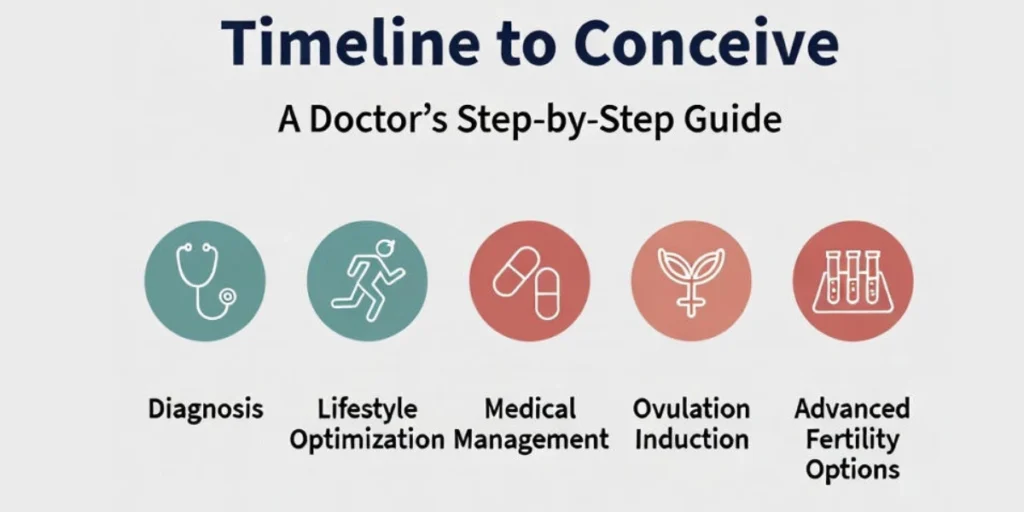
PCOS Treatment Timeline to Conceive: A Doctor’s Step-by-Step Guide
Introduction
Polycystic Ovary Syndrome (PCOS) is one of the most common endocrine disorders affecting women of reproductive age and remains a leading, yet treatable, cause of infertility worldwide. As a practicing physician, I routinely counsel patients who arrive overwhelmed, confused, and emotionally exhausted after months or even years of unsuccessful attempts to conceive. Almost invariably, their first and most pressing concern is timing: how long will this take? Understanding the PCOS treatment timeline to conceive is not merely an academic exercise—it is central to emotional reassurance, realistic planning, and treatment adherence.
PCOS affects approximately 8–13% of women globally, yet many remain undiagnosed until fertility becomes a concern. The syndrome disrupts ovulation through a complex interaction of hormonal imbalance, insulin resistance, and ovarian dysfunction. Importantly, PCOS-related infertility is among the most reversible forms of female infertility when managed appropriately. With structured care, many women conceive naturally or with minimal medical assistance.
In this comprehensive, doctor-written guide, I will walk you through each phase of the PCOS fertility journey, outlining realistic timelines, success rates, and evidence-based interventions so you can approach conception with confidence rather than uncertainty.
1. Understanding PCOS and Fertility
1.1 How PCOS Affects Ovulation and Conception
PCOS is fundamentally a disorder of hormonal dysregulation. Its impact on fertility stems from several interrelated physiological mechanisms that impair regular ovulation and optimal egg development.
The most prominent mechanism is chronic anovulation, where the ovary fails to release a mature egg each month. Elevated luteinizing hormone (LH) levels and excess androgens interfere with follicular maturation, causing multiple small follicles to arrest in development. These follicles are visible on ultrasound as the classic “polycystic” appearance, although the presence of cysts alone does not define PCOS.
Insulin resistance plays a central role. Elevated insulin levels stimulate ovarian androgen production, further suppressing ovulation and contributing to symptoms such as acne, hirsutism, and scalp hair thinning. Over time, this hormonal environment may also impair endometrial receptivity, making implantation more difficult even when ovulation occurs.
From a fertility standpoint, it is critical to understand that PCOS usually affects egg release, not egg quantity. Most women with PCOS have a high ovarian reserve, which explains why fertility outcomes improve dramatically once ovulation is restored. This biological reality underpins the generally favorable PCOS treatment timeline to conceive when evidence-based interventions are applied.
1.2 Can Women with PCOS Get Pregnant Naturally?
Yes, and many do. Women with mild PCOS or those who successfully address insulin resistance through lifestyle modification may resume spontaneous ovulation. Clinical data suggest that up to 40% of women with PCOS will ovulate naturally over time, particularly when BMI, diet, and metabolic health are optimized. However, relying solely on chance ovulation without structured monitoring may unnecessarily prolong the time to conception, which is why a guided PCOS treatment timeline to conceive is strongly recommended.
2. Treatment Phases
Step 1: Diagnosis Phase (Month 0–1)
Diagnosing PCOS Before Starting the Treatment Timeline
The first step in the PCOS treatment timeline to conceive is accurate diagnosis. PCOS is diagnosed using the Rotterdam criteria, requiring two of the following three:
- Irregular or absent ovulation
- Clinical or biochemical signs of hyperandrogenism
- Polycystic ovaries on ultrasound
Common diagnostic tests include:
- Hormonal blood tests (LH, FSH, testosterone, prolactin, TSH)
- Fasting glucose and insulin levels
- Pelvic ultrasound
This phase typically takes 2–4 weeks and is critical to exclude other causes of infertility such as thyroid disease or hyperprolactinemia.
Step 2: Lifestyle Optimization Phase (Months 1–3)
Lifestyle Changes That Start the PCOS Treatment Timeline to Conceive
Lifestyle modification is not an optional adjunct—it is the physiological foundation of PCOS fertility treatment. In many cases, it is the single most powerful intervention available. From a clinical perspective, this phase determines how well subsequent medical treatments will work.
Even modest weight loss has profound endocrine effects. A reduction of just 5–10% of body weight can restore ovulation, normalize menstrual cycles, and improve insulin sensitivity. This effect is not cosmetic; it directly alters ovarian hormone production and follicular dynamics.
Key lifestyle interventions include:
- Weight optimization: Gradual, sustainable fat loss rather than rapid dieting
- Nutrition: Low-glycemic-index, high-fiber, anti-inflammatory diets
- Physical activity: Combination of aerobic exercise and resistance training
- Sleep hygiene: Addressing circadian rhythm disruption
- Stress reduction: Cortisol control through mindfulness and behavioral therapy
| Lifestyle Change | Physiological Benefit | Expected Timeline |
| Weight reduction | Improved ovulation | 6–12 weeks |
| Low-GI diet | Reduced insulin resistance | 4–8 weeks |
| Exercise | Improved androgen profile | 4–6 weeks |
| Sleep optimization | Hormonal regulation | 2–4 weeks |
Clinically, many women ovulate for the first time in months during this phase alone. For this reason, the lifestyle phase is often the most underestimated yet decisive segment of the PCOS treatment timeline to conceive.
Weight reduction | Improved ovulation | 6–12 weeks
Low-GI diet | Reduced insulin resistance | 4–8 weeks
Regular exercise | Hormonal balance | 4–6 weeks
For many women, this phase alone shortens the PCOS treatment timeline to conceive significantly.
Step 3: Medical Management Phase (Months 2–6)
Medications in the PCOS Treatment Timeline to Conceive
If ovulation does not resume with lifestyle changes, medications are introduced.
Common medical treatments include:
- Metformin: Improves insulin sensitivity and ovulation
- Myo-inositol and D-chiro-inositol: Support hormonal regulation
- Cycle-regulating agents: Used temporarily before ovulation induction
Metformin typically requires 6–12 weeks to show ovulatory improvement. Many patients using fertility guidance from https://erectileandfertilityguide.com understand that patience during this phase is essential.
How Long Do Medications Take to Work in PCOS?
- Ovulation may resume within 2–3 months
- Menstrual cycles become more regular
- Androgen levels gradually decline
Step 4: Ovulation Induction Phase (Months 3–9)
Ovulation Induction in the PCOS Treatment Timeline to Conceive
When spontaneous ovulation does not occur, ovulation induction is initiated.
First-line treatment: Letrozole
Alternative: Clomiphene citrate
| Feature | Letrozole | Clomiphene |
| Ovulation rate | Higher | Moderate |
| Multiple pregnancy risk | Lower | Higher |
| Endometrial effect | Favorable | Anti-estrogenic |
Ovulation usually occurs within the first 1–3 cycles. With proper monitoring, pregnancy often occurs within 3–6 months during this phase of the PCOS treatment timeline to conceive.
Step 5: Advanced Fertility Treatments (Months 6–18)
When Natural Conception Fails in PCOS
If ovulation induction with oral agents does not result in pregnancy after 3–6 well-monitored cycles, escalation to advanced fertility treatments is appropriate. This decision is not a failure—it reflects individualized, evidence-based care.
Advanced treatment options include:
- Injectable gonadotropins: Direct ovarian stimulation under ultrasound monitoring
- Intrauterine insemination (IUI): Sperm placement timed precisely with ovulation
- In vitro fertilization (IVF): Laboratory fertilization with controlled embryo transfer
Injectable therapies require careful dose adjustment in PCOS patients due to heightened ovarian sensitivity. Modern protocols emphasize low-dose stimulation to minimize multiple pregnancy and OHSS risk.
IVF Success Rates in PCOS Patients
From a physician’s standpoint, PCOS patients often have excellent IVF prognoses. High antral follicle counts and robust ovarian reserve translate into favorable embryo yield. Current data demonstrate pregnancy rates of 40–60% per cycle in women under 35, with cumulative success increasing over multiple cycles.
Importantly, IVF is no longer a last resort but a strategic option within the PCOS treatment timeline to conceive, particularly when additional male-factor or tubal issues coexist.
Natural and Complementary Therapies
Natural Ways to Support the PCOS Treatment Timeline to Conceive
Evidence-based complementary strategies include:
- Vitamin D supplementation
- Omega-3 fatty acids
- Acupuncture (adjunctive)
Herbal treatments should be used cautiously and only under medical supervision.
3. Factors That Affect How Long It Takes to Conceive with PCOS
3.1 Why the PCOS Treatment Timeline to Conceive Differs for Every Woman
Key variables include:
- Age
- BMI
- Severity of insulin resistance
- Partner fertility
- Treatment adherence
Understanding these factors prevents unrealistic expectations and improves outcomes.
3.2 PCOS Treatment Timeline to Conceive: Month-by-Month Overview
| Timeframe | Treatment Phase | Expected Outcome |
| Month 0–1 | Diagnosis | Confirm PCOS |
| Month 1–3 | Lifestyle | Possible ovulation |
| Month 3–6 | Medications | Cycle regulation |
| Month 6–9 | Ovulation induction | Pregnancy |
| Month 9–18 | ART | Higher success |
Lifestyle & Prevention for Long-Term Fertility
Preventing Delays in the PCOS Treatment
Long-term strategies include:
- Maintaining healthy weight
- Regular metabolic screening
- Continued physical activity
- Monitoring ovulatory patterns
These measures reduce miscarriage risk and improve pregnancy outcomes.
Conclusion
From a medical standpoint, the PCOS treatment timeline to conceive is structured, logical, and highly successful when followed correctly. Most women conceive within 6–12 months of targeted treatment. Early diagnosis, lifestyle optimization, and evidence-based fertility therapy are the cornerstones of success. With proper guidance and patience, pregnancy with PCOS is not only possible—it is highly achievable.
Frequently Asked Questions
- How long does it take to get pregnant with PCOS?
Most women conceive within 6–12 months of treatment. - Can PCOS patients conceive naturally without medication?
Yes, especially with lifestyle changes. - What is the fastest way to conceive with PCOS?
Weight optimization and ovulation induction. - Does metformin help you get pregnant faster with PCOS?
It improves ovulation in insulin-resistant patients. - When should IVF be considered in PCOS?
After failure of ovulation induction or IUI. - Is weight loss necessary to conceive with PCOS?
Not always, but it significantly improves outcomes. - Does PCOS increase miscarriage risk?
Yes, but proper management reduces this risk.
References
- International Evidence-Based Guideline for the Assessment and Management of PCOS: https://www.monash.edu/medicine/sphpm/mchri/pcos/guideline
- American College of Obstetricians and Gynecologists (ACOG): https://www.acog.org
- European Society of Human Reproduction and Embryology (ESHRE): https://www.eshre.eu
- PubMed – PCOS and infertility management studies: https://pubmed.ncbi.nlm.nih.gov/?term=PCOS+infertility+management
- World Health Organization (WHO) fertility guidelines: https://www.who.int/health-topics/infertility